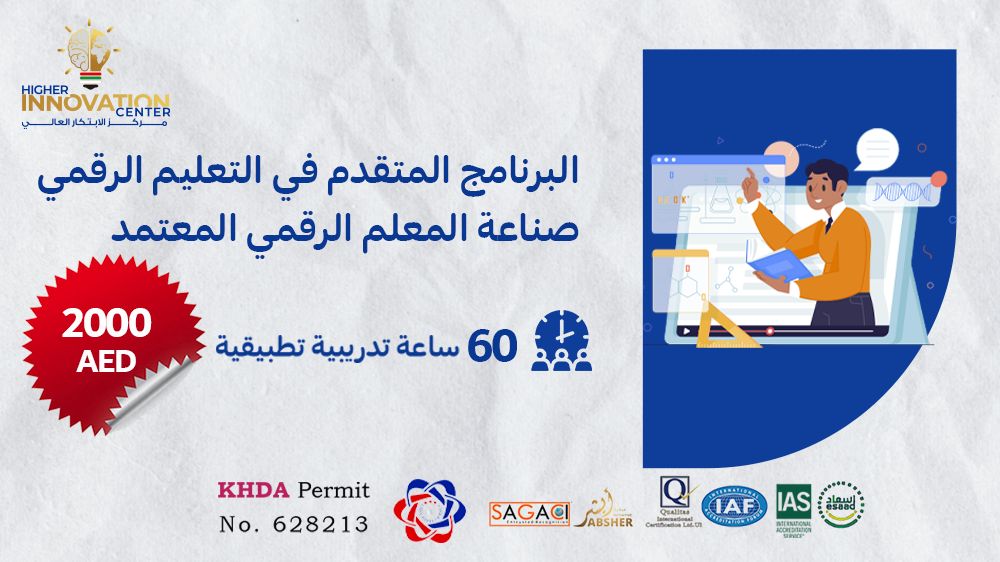
⦁ Six practical models of digital education strategies.
⦁ Web-based educational activities.
⦁ Building teachers’ capacities to employ virtual reality and augmented reality technologies in teaching and learning processes.
⦁ Developing teachers’ skills in using technology effectively in teaching and learning processes.
⦁ Enabling and leading effective interaction with students via virtual classrooms and educational platforms.
⦁ Building teachers’ capacities to produce interactive, multimedia digital educational content.
⦁ Building teachers’ capacities to employ technology in monitoring processes.
Accredited program certificates
⦁ A certified and accredited certificate from the International Centre for Digital Accreditation (CIDA) in France
⦁ A one-year membership card from the International Centre for Digital Accreditation (CIDA) in France
⦁ A certified certificate issued by the Knowledge and Human Development Authority (KHDA) – Government of Dubai
⦁ A certified and accredited certificate from the Higher Innovation Centre – UAE
Targeted people
⦁ All teachers, professors, teaching assistants, university faculty members, supervisors, schools, and all those interested in professional teaching and digital education.
Augmented reality in education
⦁ Develop models to improve students’ language interaction and communication skills.
⦁ Improve speaking skills:
⦁ Provide interactive models to improve students’ speaking and communication skills.
⦁ Language support:
⦁ Create models to support language learning and the learning of new languages.
⦁ Provide interactive content:
⦁ Develop models to create engaging and interactive content.
⦁ Skills to integrate learning resources with the Egyptian Knowledge Bank.
⦁ Handle digital activities efficiently and effectively.
⦁ Expanding Educational Content:
⦁ Adding additional information or 3D immersion to books and paper educational materials.
⦁ Enhancing Educational Tours:
⦁ Adding additional information or interactions to natural landmarks or historical sites.
⦁ Direct Instruction and Teaching:
⦁ Using augmented reality markers to guide students and clarify educational concepts.
⦁ Job Training:
⦁ Allowing students to experience simulations of specific jobs using augmented markers.
Program themes
Virtual Reality in Education:
Virtual Journeys:
Virtual experiences and journeys for students to explore new places and cultures.
Practical Skills Training:
Interactive simulation environments to train students in practical skills, such as surgery or engineering.
Scientific Experiments:
Conducting laboratory science experiments in a safe, virtual environment.
Enhancing Language Learning:
Creating virtual environments to improve speaking and listening skills in new languages.
⦁ Artificial Intelligence in Teaching and Learning.
⦁ The Concept and Requirements of Digital Education.
⦁ Student Characteristics in the Digital Age.
⦁ Using Digital Learning Environments in Their Forms in the Teaching and Learning Process.
⦁ Effective Digital Communication with All Elements of the Educational Process.
⦁ Converting Educational Content into Interactive Multimedia Digital Content (Video Production, Animated Video Production, Gamification, etc.)
⦁ The Latest Strategies in the Field of Digital Education.
Training strategies
⦁ Digital teaching skills simulation assessment.
⦁ Attendance of at least 80% of training.
⦁ Completion of training assignments, tests, and tasks.
⦁ Submission of the graduation project by the specified deadlines.
⦁ Achieving a 70% score on the final exam.
⦁ A range of modern, interactive, and participant-centered digital training strategies will be employed.
⦁ Evaluation Methods
⦁ Participants will be evaluated using a comprehensive assessment method throughout the training period, including the following:
⦁ A pre-training assessment of cognitive and skill aspects.
⦁ A formative assessment during the training.
⦁ A final assessment to measure the effectiveness of the training.
Certificates awarded
High Innovation Academy - UAE
International Center for Digital Accreditation CIDA France
Knowledge and Human Development Authority - Dubai
Contact us today!
Start your knowledge adventure now by connecting with us – and
unlock a world of interactive e-learning experiences!